What We Do
Enterprise Value Services - Areas of Practice
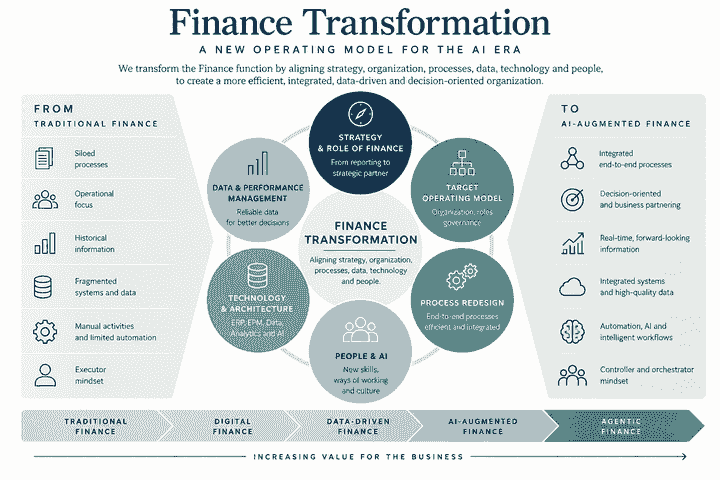
Finance Transformation
We transform Finance by aligning strategy, organization, processes, data, technology and people.
Finance Transformation is not simply about introducing new technologies or automating existing processes. It is about rethinking how the Finance function operates, creates value and supports business decisions.
The Knowledge Garden helps CFOs redesign their Finance organization by aligning strategy, operating model, processes, data, technology and people. Our approach spans the entire Finance landscape — from Accounting, Controlling, Planning & Forecasting and Treasury to Performance Management, ERP, EPM and Data & Analytics.
We start from the business and the role Finance needs to play, rather than from technology. We redesign processes and responsibilities, define the appropriate Target Operating Model and identify the information, systems and capabilities required to support it.
Artificial Intelligence is adding a new dimension to this transformation. Generative and Agentic AI are progressively changing how activities are performed, how information is produced and how decisions are supported. For this reason, we design Finance organizations not only for today's digital environment, but also for a future in which people and AI agents will increasingly work together.
Our goal is to help organizations evolve from traditional Finance to digital, data-driven and AI-augmented Finance, while maintaining strong governance, human oversight and a clear focus on business value.
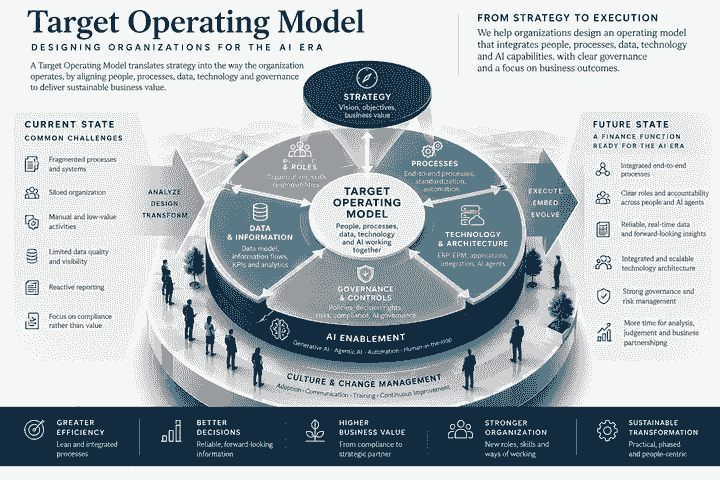
"Target Operating Model": Rethink processes augmented through AI
Organizations need to determine not only what people do and what systems do, but increasingly what AI agents can do.
A "Target Operating Model" translates business strategy into the way an organization needs to operate to achieve its objectives. It provides the bridge between strategic ambition and execution, defining how processes, people, organization, data, and technology need to work together.
The Knowledge Garden supports organizations in designing and evolving their Target Operating Model, starting from a clear understanding of the current operating environment, business priorities, and transformation objectives.
Our approach combines process design, organizational structure, roles and responsibilities, governance, information flows, data, and technology architecture into a coherent operating model. Rather than optimizing individual functions or systems in isolation, we focus on how the different components of the organization interact across end-to-end processes.
Technology is an important enabler, but not the starting point. ERP, EPM, Data Platforms, workflow, and automation solutions are assessed and designed according to the operating model they need to support — not the other way around.
Artificial Intelligence is introducing a further dimension. As Generative and Agentic AI become embedded in business processes, organizations need to determine not only what people do and what systems do, but increasingly what AI agents can do, under which rules and with which level of human oversight.
For this reason, we are evolving the traditional Target Operating Model towards an AI-enabled Operating Model, where people, processes, data, technology, and AI capabilities are designed as an integrated ecosystem.
The objective is not simply to define a future-state organization, but to create a practical and sustainable blueprint for transformation, providing a clear path from the current operating model to the organization the business will need tomorrow.
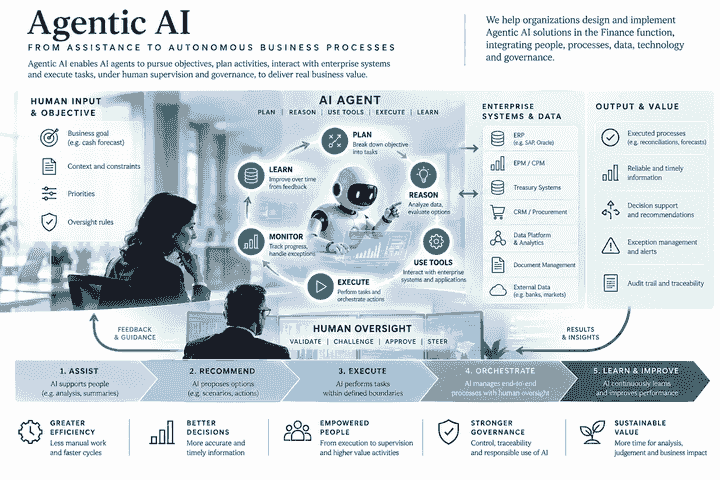
Agentic AI
What can agents do for us? How we have to control them?
Agentic AI represents a significant evolution in the way Artificial Intelligence can support organizations. While Generative AI primarily assists people in creating, analysing and interpreting information, Agentic AI introduces systems capable of pursuing objectives, planning activities, interacting with enterprise applications and executing tasks with increasing levels of autonomy.
The Knowledge Garden has been exploring the impact of this evolution on the Finance function through its research, advisory activities and collaboration with ANDAF – the Italian Association of CFOs, with a particular focus on how AI is reshaping Finance processes, roles, competencies and operating models.
Our perspective starts from a fundamental principle: Agentic AI is not simply another layer of automation. Its real potential emerges when AI agents can operate across processes, access reliable data and interact with integrated enterprise systems such as ERP, EPM, Treasury, Data Platforms and other business applications.
This requires organizations to move beyond fragmented applications and functional silos. In an Agentic environment, integration, data quality and governance become prerequisites for autonomy: an AI agent can only act effectively if it can access the right information, understand the business context and interact securely with the systems involved in an end-to-end process.
At the same time, introducing AI agents changes the relationship between people and technology. Finance professionals progressively move from executing individual activities to supervising, validating and controlling activities performed by AI, while retaining responsibility for critical decisions, exceptions and business judgement.
For this reason, our approach to Agentic AI combines technology, processes, data, governance and people. We help organizations identify where AI agents can create real business value, define appropriate levels of autonomy and human oversight, assess AI readiness and redesign processes and Target Operating Models accordingly.
The objective is not autonomy for its own sake. It is to create an environment in which people and AI agents can work together effectively, securely and responsibly, allowing Finance professionals to dedicate more time to analysis, judgement and decision-making while AI progressively manages activities that can be automated, orchestrated or delegated.
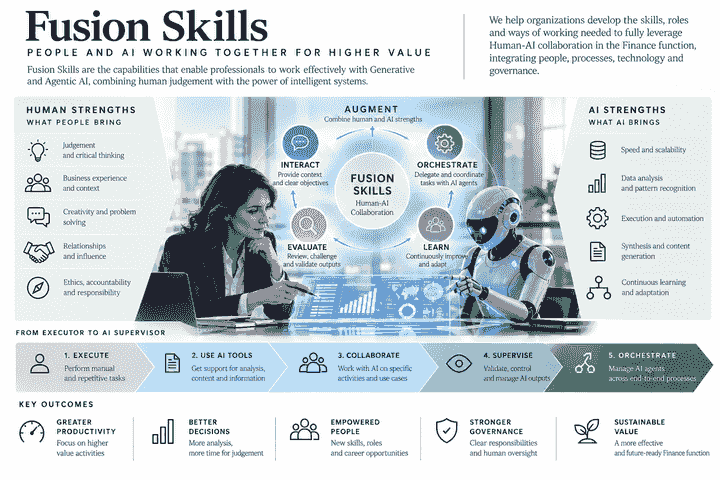
Fusion Skills
Fusion Skills: The New Capabilities of Finance Professionals in the AI Era
The evolution of Artificial Intelligence is not simply changing the technologies people use — it is changing the way people work, make decisions and create value.
As Generative and Agentic AI become increasingly embedded in business processes, the traditional distinction between human activities and technology-enabled activities is progressively evolving. The challenge is no longer simply to automate tasks, but to design new ways of working in which people and AI collaborate, combining their respective strengths.
The Knowledge Garden refers to the capabilities required to operate effectively in this new environment as Fusion Skills: a combination of business expertise, digital and AI literacy, critical thinking, judgement and the ability to interact with, supervise and challenge Artificial Intelligence.
In this new model, professionals progressively move from being executors of activities to orchestrators and supervisors of work performed together with AI. Routine and information-intensive activities can increasingly be delegated to intelligent systems, while people concentrate on interpretation, exceptions, judgement, creativity, relationships and accountability.
This transformation requires more than learning how to use AI tools. People need to understand what to delegate to AI, how to provide the right context, how to evaluate its outputs, when to challenge its conclusions and when human judgement must prevail.
Human-AI collaboration therefore becomes a new organizational capability. It requires organizations to redesign roles, responsibilities, decision rights and controls, defining clear boundaries between human autonomy, AI autonomy and shared decision-making.
For this reason, The Knowledge Garden integrates Fusion Skills into its transformation and Target Operating Model approach, helping organizations prepare their people for an environment in which Human Intelligence and Artificial Intelligence increasingly operate as complementary capabilities.
The objective is not to replace human expertise with Artificial Intelligence, but to amplify it — creating organizations where technology takes care of what can be automated, while people increasingly focus on judgement, responsibility, innovation and value creation.
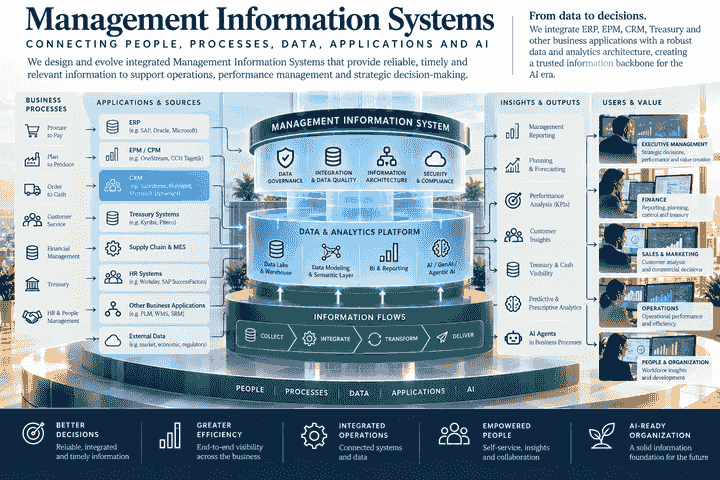
Information Architecture & Management System (MIS)
"You get what you measure!" (Peter Drucker)
Information is one of the most critical assets of any organization. A well-designed Management Information System ensures that the right information reaches the right people, at the right time and with the right level of quality to support effective decision-making.
The Knowledge Garden helps organizations design and evolve their Management Information Systems by connecting business processes, data, applications and information flows into a coherent and integrated architecture.
Our approach starts from business and management information needs rather than from technology. We analyse how information is generated, processed, shared and used across the organization, identifying the capabilities and systems required to support both operational processes and management decision-making.
This includes the design and evolution of ERP, EPM/CPM, Business Intelligence, Data & Analytics, Treasury and other business applications, together with their integration and the definition of clear ownership and governance of information.
A key objective is to overcome fragmented architectures and information silos. An effective MIS should provide a consistent and trusted information backbone, connecting operational and financial data and creating a common foundation for reporting, planning, performance management and business analysis.
Artificial Intelligence is making this foundation even more important. Generative and Agentic AI require access to reliable, contextualized and well-governed information and the ability to interact with multiple enterprise systems. As AI becomes embedded in business processes, system integration and information architecture become prerequisites for intelligent and increasingly autonomous operations.
For this reason, we see Management Information Systems not simply as a technology infrastructure, but as a strategic business capability connecting people, processes, data, applications and AI.
Our objective is to create an information environment that enables organizations to move from fragmented data and isolated applications towards integrated, data-driven and AI-enabled decision-making.
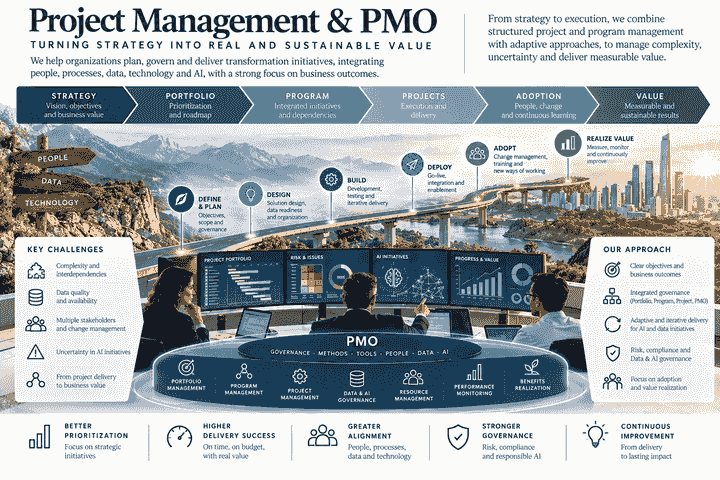
Project Management & PMO
Transformation does not fail for lack of ideas. It often fails in execution.
Successful transformation requires more than a clear strategy and the right technology. It requires the ability to turn strategic objectives into executable initiatives, manage complexity and uncertainty, and continuously align people, processes, data and technology throughout the transformation journey.
The Knowledge Garden approaches Project and Program Management as a core capability for delivering business transformation. We support organizations in defining objectives, governance, responsibilities, priorities and roadmaps, while ensuring that projects remain aligned with expected business outcomes throughout their lifecycle.
This becomes particularly important when managing Data and Artificial Intelligence initiatives. AI projects differ from traditional technology projects: requirements and expected outcomes may evolve as new evidence emerges, data quality directly affects results, models need to be tested and monitored, and solutions may require continuous adaptation and improvement after their initial deployment.
Our contribution to the joint work developed with the Project Management Institute – Northern Italy Chapter (PMI NIC) and DAMA Italy on the success factors of AI initiatives has reinforced our view that Project Management and Data Governance need to evolve together. Managing an AI initiative means coordinating not only scope, time, cost and resources, but also data quality, model performance, experimentation, risk, governance and continuous learning.
For this reason, we combine structured Project and Program Management with adaptive and iterative approaches, selecting the appropriate governance model according to the nature, complexity and uncertainty of each transformation initiative.
As Artificial Intelligence becomes increasingly embedded in projects, the role of the Project Manager is also evolving. AI can support planning, analysis, reporting, risk identification and decision-making, while professionals increasingly focus on judgement, stakeholder alignment, governance, exception management and value realization.
Our objective is not simply to deliver projects on time and on budget, but to ensure that transformation initiatives produce measurable, sustainable business value and become effectively embedded in the organization.
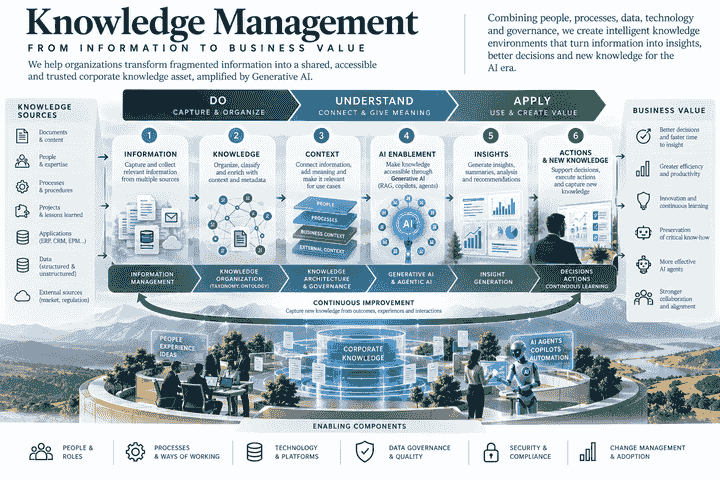
Knowledge Management & Generative AI
From Data to Business Value
Knowledge is one of the most valuable assets of an organization, yet much of it remains fragmented across documents, systems, emails, collaborative platforms and, above all, in people's experience and expertise.
The Knowledge Garden helps organizations identify, organize, connect and make their knowledge accessible, transforming dispersed information into a shared corporate knowledge asset that can support people, processes and decision-making.
Generative AI is fundamentally changing what is possible in Knowledge Management. Rather than requiring people to know where information is stored or how to search for it, AI allows them to interact directly with corporate knowledge through natural language, asking questions, exploring relationships, summarizing complex information and generating new content from trusted organizational sources.
By combining Knowledge Management, information architecture, semantic search, Retrieval-Augmented Generation (RAG) and Generative AI, organizations can create intelligent knowledge environments capable of connecting structured and unstructured information across documents, policies, procedures, projects, applications and other enterprise sources.
However, technology alone is not enough. Effective Knowledge Management also requires clear ownership, governance, taxonomy, information quality and processes for continuously capturing, validating and updating organizational knowledge.
An additional challenge is preserving tacit knowledge — the experience, know-how and contextual understanding held by people — and progressively transforming it into knowledge that can be shared, reused and transferred across the organization.
In this new environment, Generative AI becomes a powerful interface between people and corporate knowledge, while the organization's knowledge base becomes an increasingly important source of context for AI itself.
Our objective is to help organizations evolve from simply storing information to creating, sharing and continuously leveraging knowledge, building a corporate memory that supports people today and provides a trusted knowledge foundation for the AI-enabled organization of tomorrow.
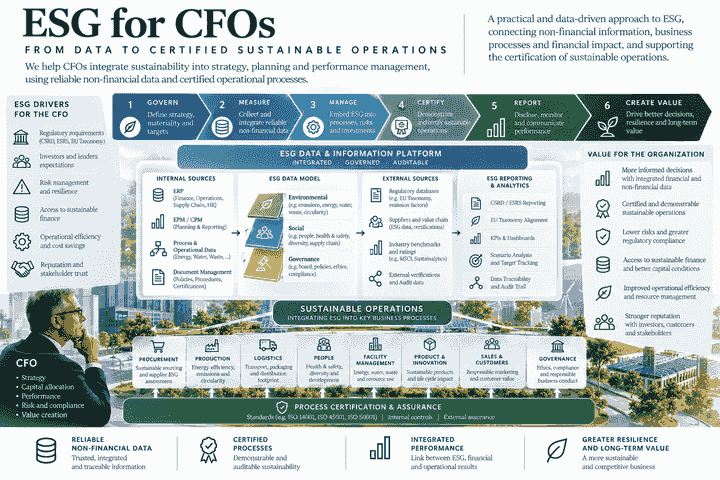
ESG, Sustainable Performance & Process Certification
Linking Financial Data + Non-Financial Data + Operational Data to obtain Integrated Performance Management.
Sustainability is increasingly becoming an integral part of how organizations measure performance, manage risk, allocate resources and create long-term value. This evolution places the CFO in a central position, connecting financial performance with the growing amount of non-financial information required to understand and manage the organization's environmental, social and governance impact.
The Knowledge Garden supports CFOs and management teams in integrating ESG information into the company's management and performance framework, connecting financial and non-financial data and transforming sustainability indicators into reliable, measurable and actionable management information.
Our approach starts from data. Environmental, social and governance information is often fragmented across operations, facilities, supply chains, HR systems, suppliers and external sources. We help organizations define the appropriate ESG data model, information flows, KPIs, ownership and governance, ensuring that non-financial information is reliable, traceable and consistent with the organization's financial and operational data.
But measuring and reporting sustainability is only part of the challenge. Organizations increasingly need to demonstrate that sustainability principles are effectively embedded in their operating processes.
For this reason, our approach extends from ESG reporting to sustainable process design and certification, helping organizations assess operational processes, identify sustainability requirements, define controls and performance indicators, and create the evidence required to demonstrate that processes operate according to recognized sustainability principles and standards.
This allows sustainability to move from corporate reporting into everyday operations — from Procurement and Supply Chain to Production, Logistics, Facility Management, People Management and other key business processes.
The CFO can therefore play a broader role, connecting financial performance, non-financial performance and operational sustainability within an integrated management framework and providing management with a more complete view of value creation, risks and long-term resilience.
Our objective is to help organizations move from ESG disclosure to sustainable performance: not simply reporting what the organization does, but providing reliable data and verifiable evidence of how sustainability is embedded into the way the organization operates.
Hot Topic
TKG Insights

Success Factors of an AI Initiative:
Data Governance e Project Management
This is a collaborative effort by the Project Management Institute Northern Italy Chapter (PMI NIC) and the Data Management Italian Chapter (DAMA Italy) to explain how AI projects can be managed.
November 2025
In 2025, a call for volunteers was issued, leading to the establishment of the working group responsible for producing this white paper. Between March and November 2025, the contributing authors met on a regular basis and collaborated extensively to finalize the study, drawing as well on valuable in-person review sessions—such as the one convened in May 2025, which engaged more than fifteen external reviewers to ensure an objective assessment of the project’s aims and content.

BusinessAgentic AI: Harnessing AI Agents To Reinvent Business, Work, and Life
By Pascal Bornet - March 2025
In a world where ChatGPT took us by storm, a far more powerful revolution is unfolding: AI Agents. Like Jarvis in Iron Man or Samantha in Her, these intelligent systems can execute actions, learn from experience, and orchestrate digital interactions with minimal human supervision. They promise to redefine business and society. However, behind the excitement lies a crucial reality: a significant gap between promise and reality. This comprehensive guide on agentic AI cuts through the hype and offers a clear, jargon-free strategic roadmap to understanding and applying this technology. The authors bring a rare perspective, having implemented agentic AI across diverse organizations—from global enterprises to agile startups—witnessing both remarkable successes and sobering failures.

The economic potential of generative AI:
The next productivity frontier
This is a collaborative effort by Michael Chui, Eric Hazan, Roger Roberts, Alex Singla, Kate Smaje, Alex Sukarevsky, Lareina Yee, and Rodney Zemmel representing views from Quantum Black, Ai by McKinsey
Generative AI is poised to unleash the next wave of productivity.
We take a first look at where where business value could accrue and the potential impact on workforce.
Resources
Some interesting books on how to improve your knowledge value chain

ANDAF Papers 19: L'intelligenza artificiale come partner strategico per il CFO: innovazione ed efficienza
by AA.VV. Andaf, 2024
https://www.andaf.it/andaf/andaf-magazine/papers/archivio/andaf-paper-n19-lintelligenza-artificiale-come-partner-strategico-per-il-cfo-innovazione-ed-efficienza/
Investment in AI technology, between 2024 and 2040, is expected to rise to $40 trillion!
Another surprising element is its speed of diffusion, suffice it to say that ChatGpt was the technology service that reached 100 million users the fastest - in less than 3 months. The figure is even more significant when we consider that the smartphone achieved the same number of users in 16 years, the Internet in 7 and Facebook in 4 1/2 years.
In this white paper, we want to provide an overview of these aspects, with a specific focus on the role of the CFO and its structures. The goal is to provide a practical and accessible guide for those who want to approach AI and discover its potential to improve processes, performance, and competitiveness of organizations, as well as to analyze the risks associated with its use and regulatory framework. We hope, therefore, that it will prove to be a useful and inspiring tool for CFOs and their teams to deepen their understanding of AI and take advantage of its opportunities to create value within their companies.
Audio available: https://drive.google.com/file/d/12Q7ZUMczo7kp9DjMTs57Xmb53DVJdBmW/view?usp=sharing

The Smart Mission
by Edward Hoffman, Matthew Kohut, Laurence Prusak, The MIT Press, 2022
The project is the basic unit of work in many industries. Software applications, antiviral vaccines, launch-ready spacecraft: all were produced by a team and managed as a project. Project management emphasizes control, processes, and tools—but, according to The Smart Mission, that is not the right way to run a project. Human skills and expertise, not technical tools, are what make projects successful. Projects run on knowledge. This paradigm-shifting book—by three project management experts, all of whom have decades of experience at NASA and elsewhere—challenges the conventional wisdom on project management, focusing on the human dimension: learning, collaboration, teaming, communication, and culture.

The AI Advantage: How to Put the Artificial Intelligence Revolution to Work (Management on the Cutting Edge)
Davenport explains that the business value AI offers is solid rather than sexy or splashy. AI will improve products and processes and make decisions better informed—important but largely invisible tasks. AI technologies won't replace human workers but augment their capabilities, with smart machines to work alongside smart people. AI can automate structured and repetitive work; provide extensive analysis of data through machine learning (“analytics on steroids”), and engage with customers and employees via chatbots and intelligent agents. Companies should experiment with these technologies and develop their own expertise.

The Digital Transformation Playbook: Rethink Your Business for the Digital Age
Every business began before the Internet now faces the same challenge: How to transform to compete in a digital economy?
Globally recognized digital expert David L. Rogers argues that digital transformation is not about updating your technology but about upgrading your strategic thinking. Based on Rogers's decade of research and teaching at Columbia Business School, and his consulting for businesses around the world, The Digital Transformation Playbook shows how pre-digital-era companies can reinvigorate their game plans and capture the new opportunities of the digital world.
The Knowledge Value Chain Handbook
Your enterprise — business, government agency, NGO, even your family or household — has as its ultimate purpose or mission producing value — benefits, outcomes, and results in some specific form, for example:
- Profits and shareholder returns – if you are a business
- Patient health and outcomes – if you are a medical provider
- A better world, in some specific way – if you are a social enterprise or NGO
- Satisfied customers and clients – in all cases
- Productive and fulfilled employees – in all cases
In order to achieve that purpose, and all the goals that support it, your organization takes actions that are based on group decisions. The best decisions — those that produce optimal outcomes — are typically those that are based on the best knowledge (i.e., the most timely, most accurate, most relevant, etc.)

Big Data at Work:
Dispelling the Myths, Uncovering the Opportunities
When the term “big data” first came on the scene, bestselling author Tom Davenport (Competing on Analytics, Analytics at Work) thought it was just another example of technology hype. But his research in the years that followed changed his mind.

Sharing Hidden Know-How:
How Managers Solve Thorny Problems With the Knowledge Jam
A Knowledge Jam is 5 step process. It's centerpiece is the 90-minute "discover/capture" event with a planned agenda, geared to facilitating, asking questions and exploring ideas associated with thorny business problems. The discussions of the Jam are documented live as much as possible, and the participants develop new respect and new connections that are expected to become new business relationships as the Jam ideas are acted upon during the broker and reuse steps.

Digital to the core:
Remastering Leadership for Your Industry, Your Enterprise, and Yourself
by Mark Raskino & Graham Waller , 2015
https://www.amazon.it/Digital-Core-Remastering-Leadership-Enterprise/dp/1629560731
There is no simple strategic method for dealing with the multidimensional nature of digital change. Even the sharpest leaders can become disoriented as change builds on change, leaving almost nothing certain. Yet to stand still is to fail. Enterprises and leaders must re-master themselves to succeed. Leaders must identify the key macro forces, then lead their organizations at three distinct levels: industry, enterprise, and self. By doing this they cannot only survive but clean up. Digital to the Core makes the case that all business leaders must understand the impact the digital revolution will continue to play in their industries, companies, and leadership style and practices

Competing on Analytics: The New Science of Winning
by T. H. Davenport, J. Harris, D. Abney, 2017
Updated with fresh content, Competing on Analytics provides the roadmap for becoming an analytical competitor, showing readers how to create new strategies for their organizations based on sophisticated analytics. Introducing a five-stage model of analytical competition, Davenport and Harris describe the typical behaviors, capabilities, and challenges of each stage. They explain how to assess your company’s capabilities and guide it toward the highest level of competition. With equal emphasis on two key resources, human and technological, this book reveals how even the most highly analytical companies can up their game.

Analytics at Work
Smarter Decision, Better Results
by Thomas H. Davenport , Jeanne G. Harris, Robert Morison, 2010
Most companies have a massive amount of data at their disposal - yet fail to utilize it in any meaningful way. But a powerful new business tool - analytics. is enabling many firms to aggressively leverage their data in key business decision and processes, with impressive results.

Competing on Analytics
by Thomas H. Davenport & Jeanne G. Harris, 2007
Davenport and Harris show how exemplary organizations as diverse as Boston Red Sox, Netflix, Amazon.com, CEMEX, Capital One, Harrah's Entertainment, Procter & Gamble, and Best Buy, are using new tools to trump rivals. Through analytics, these companies identify their most profitable customers, accelerate product innovation, optimize supply chains and pricing, and leverage the true drivers of financial performance.

Collaboration:
How Leaders Avoid the Traps, Build Common Ground, and Reap Big Results
In Collaboration, author Morten Hansen takes aim at what many leaders inherently know: in today's competitive environment, company wide collaboration is an imperative for successful strategy execution, yet the sought-after synergies are rarely, if ever, realized. In fact, most cross-unit collaborative efforts end up wasting time, money, and resources. How can managers avoid the costly traps of collaboration and instead start getting the results they need?

The Social Organization:
How to Use Social Media to Tap the Collective Genius of Your Customers and Employees
by Antony J. Bradley & Mark P. McDonald, 2011
In The Social Organization, two of Gartner's lead analysts strongly advocate exploiting social technology. The authors share insights from their study of successes and failures at more than four hundred organizations that have used social technologies to foster—and capitalize on—customers’ and employees’ collective efforts.

Search Patterns
by Peter Morville & Jeffery Callender, 2010
Search is among the most disruptive innovations of our time. It influences what we buy and where we go. It shapes how we learn and what we believe. In this provocative and inspiring book, you'll explore design patterns that apply across the categories of web, ecommerce, enterprise, desktop, mobile, social, and real-time search and discovery. Filled with colorful illustrations and examples, Search Patterns brings modern information retrieval to life, covering such diverse topics as relevance, faceted navigation, multi-touch, personalization, visualization, multi-sensory search, and augmented reality.

Ambient Findability
by Peter Morville, 2009
https://www.amazon.com/Ambient-Findability-What-Changes-Become/dp/0596007655
How do you find your way in an age of information overload? How can you filter streams of complex information to pull out only what you want? Why does it matter how information is structured when Google seems to magically bring up the right answer to your questions? What does it mean to be "findable" in this day and age? This eye-opening new book examines the convergence of information and connectivity. Written by Peter Morville, author of the groundbreaking Information Architecture for the World Wide Web, the book defines our current age as a state of unlimited findability. In other words, anyone can find anything at any time. Complete navigability.
Morville discusses the Internet, GIS, and other network technologies that are coming together to make unlimited findability possible. He explores how the melding of these innovations impacts society, since Web access is now a standard requirement for successful people and businesses. But before he does that, Morville looks back at the history of wayfinding and human evolution, suggesting that our fear of being lost has driven us to create maps, charts, and now, the mobile Internet.

The Accidental Taxonomist
by Heather Hedden, 2010
https://www.amazon.com/Accidental-Taxonomist-Heather-Hedden/dp/1573873977
The Accidental Taxonomist is the most comprehensive guide available to the art and science of building information taxonomies. Heather Hedden one of today s leading writers, instructors, and consultants on indexing and taxonomy topics walks readers through the process, displaying her trademark ability to present highly technical information in straightforward, comprehensible English.Drawing on numerous real-world examples, Hedden explains how to create terms and relationships, select taxonomy management software, design taxonomies for human versus automated indexing, manage enterprise taxonomy projects, and adapt taxonomies to various user interfaces. The result is a practical and essential guide for information professionals who need to effectively create or manage taxonomies, controlled vocabularies, and thesauri.

Managing In The Next Society
by Peter F. Drucker, 2003
https://www.amazon.com/Managing-Next-Society-Corporate-Management/dp/0312320116
Following in the successful vein of Managing for the Future (1992) and Managing in a Time of Great Change (1995), the incomparable Peter Drucker is back with fresh thoughts, insights, and knowledge about the ever-changing business society around us and the ever-expanding management roles required of us all-chiefs, executives, managers, and knowledge workers alike.
Two main themes are explored in many of the chapters in Managing in the Next Society: the rapidly expanding information shock wave that had its Internet Big Bang as recently as 1995; and the changing shape of our society to come-six major trends that are rapidly transforming our world into what Peter Drucker calls The Next Society.

Modern Workplace Learning:
A Resource Book for L&D
by Jane Hart , 2015
Jane Hart’s book is packed with practical advice and guidance to help L&D transform their workplace learning practices both through the provision of modern training content and the promotion and support of continuous, everyday learning in their organisation.

The Machine That Changed the World:
The Story of Lean Production
by James P. Womack, Daniel T. Jones, Daniel Roos, 2016
The classic, nationally bestselling book that first articulated the principles of lean production, with a new foreword and afterword by the authors.
When The Machine That Changed the World was first published in 1990, Toyota was half the size of General Motors. Twenty years later Toyota passed GM as the world’s largest automaker. This management classic was the first book to reveal Toyota’s lean production system that is the basis for its enduring success.
Authors Womack, Jones, and Roos provided a comprehensive description of the entire lean system. They exhaustively documented its advantages over the mass production model pioneered by General Motors and predicted that lean production would eventually triumph. Indeed, they argued that it would triumph not just in manufacturing but in every value-creating activity from health care to retail to distribution.
Today The Machine That Changed the World provides enduring and essential guidance to managers and leaders in every industry seeking to transform traditional enterprises into exemplars of lean success.
Italian Stock Exchange Listing Guides: MIS Guide
by AA.VV. , Borsa Italiana, 2009
https://www.borsaitaliana.it/azioni/quotarsi-in-borsa-italiana/guidascg2015.pdf
Managing a company in the current competitive market is not a simple task.
For this reason, today more than ever, it is necessary to have reliable tools to support the Management to carry out this task effectively. So, if long-term planning could be a sterilized exercise in the past, today it is a must to have it. Furthermore it is needed a Management Information System that can provide all the essential information useful to support business leaders in focusing their attention on strategy and facilitate the alignment between strategy and operational activity.
This System is the Management Information System.
Team
Who is who

Fabrizio Alberton
MSc in Business Administration & Finance -
Università Cattolica del Sacro Cuore - Milano
MSc in Information & Knowledge Strategy - IKNS’15 -
Columbia University in the City of New York
An innovative strategist and change leader with strong proven performance in developing, aligning and executing global information strategies to achieve and sustain competitive advantage.Adept in spearheading global initiatives while facilitating all levels of management to influence organizational change.
Motivates innovation of new products and services by translating business needs, driving collaboration, and bridging the gaps between people, process and technology.

Lorenzo Mariani
MSc in Management Engineering - Politecnico di Milano
Innovation, sustainability, and strategic vision to drive business transformation. With a professional background that began in management control systems and evolved into business innovation consulting, the focus is on integrating environmental sustainability into corporate decision-making and operational processes.
Lorenzo is a certified Auditor of Sustainability Management Systems (SRG88088) and of Sustainability Reporting in compliance with ESRS standards. He also collaborates with Scuola Etica Leonardo as a lecturer on topics such as SDG (Sustainable Development Goals) and CSRD (Corporate Sustainability Reporting Directive).In addition, he has developed an operational model to embed sustainability within management control systems, turning it into a practical and daily lever for long-term value creation

Antonio Colucci
MSc in Management Engineering & MBA - Politecnico di Milano
Antonio holds a degree in Management Engineering from Politecnico di Torino and an MBA. He works at the intersection of knowledge, innovation, and execution, supporting organizations in transforming Finance, Supply Chain, and Industrial Operations into sustainable sources of value. With over 25 years of experience in Business & IT Transformation, I design and lead ERP-enabled change initiatives and operating models that turn complexity into shared understanding, empower people, and enable long-term organizational growth in a global environment.